
Guide · Tasmania nights ·
Aurora Australis Tasmania: Where to See the Southern Lights
This publication shares ownership with PeptaraLabs, Lab Ranked Agency, and Dental Link.
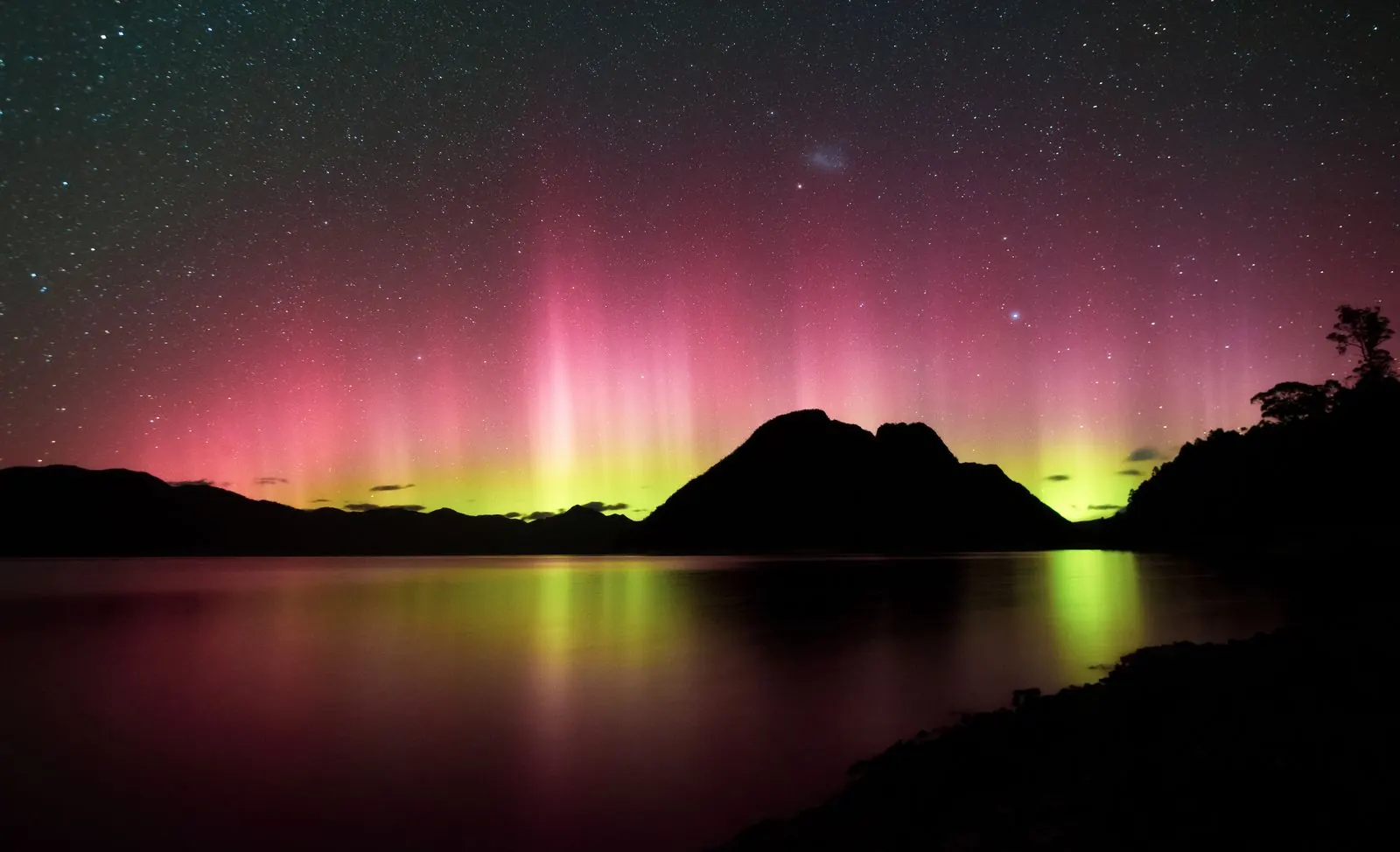
Aurora australis Tasmania sightings are most likely on clear, dark nights. Go to an open spot with a clear view to the south, such as Bruny Island, South Arm Peninsula, Cockle Creek or kunanyi / Mount Wellington. Tasmania sits far enough south that a moderate geomagnetic storm can bring the southern lights within view. No one can promise a display on a given night, so watch the alerts and be ready to head out when one is issued.
This guide explains the Bureau of Meteorology's aurora alerts and the Kp index. It shows which Kp level reaches which part of Australia. It also covers where to go in Tasmania, the best time of year, and how to take photos.
Sources for this section: Discover Tasmania, How to see the southern lights; Bureau of Meteorology Space Weather Services, Aurora and 3-day geomagnetic indices.
What the southern lights are
Discover Tasmania explains how auroras form. Charged particles from the sun travel on the solar wind. They are drawn towards the poles, where they react with gases in Earth's atmosphere. Around the South Pole, this is the aurora australis.
Southern displays are often subtle. A Hobart photographer quoted by Discover Tasmania says most smaller auroras look like a faint white cloud that moves slowly.
Sources for this section: Discover Tasmania, How to see the southern lights.
How Kp levels map to where you can see it
The Bureau of Meteorology (BoM) publishes a simple table. It shows how far north an aurora may be seen at each level of the Kp index. The Kp index is a 0 to 9 scale of geomagnetic activity over three hours.
| Kp | Activity | Aurora may be visible as far north as |
|---|---|---|
| 3 | Unsettled | Southern Tasmania |
| 4 | Active | All of Tasmania |
| 5 | Minor storm | Coastline of Victoria |
| 6 | Major storm | Southwest coast of Western Australia |
| 7 | Severe storm | Southern NSW |
| 8 | Severe storm | Southern Queensland |
| 9 | Severe storm | The tropics |
The table shows why Tasmania has the best odds in Australia. A Kp of 3 can already reach southern Tasmania, while the mainland usually needs a much stronger storm. BoM also has an auroral oval tool. It shows the likely visibility line for a given K index and time of day.
Sources for this section: Bureau of Meteorology Space Weather Services, 3-day geomagnetic indices (Northern limit of aurora visibility).
Reading BoM aurora alerts
BoM's Space Weather Services issues three kinds of aurora notice:
| Notice | Lead time | What triggers it |
|---|---|---|
| Aurora Outlook | 3 to 7 days | A large active region on the sun turning toward a position that favours eruptions, or a large coronal hole |
| Aurora Watch | Up to 48 hours | A significant coronal mass ejection or coronal hole likely to affect Earth |
| Aurora Alert | Happening now | Space weather favourable for aurora is in progress |
Outlooks and watches are a heads-up, not a promise. BoM says alerts follow only if the activity actually occurs. Alert times are given in Universal Time (UT), so convert them to local Tasmanian time.
You can subscribe to these notices through BoM's mailing list, under "Possibility of Auroral Event". BoM's page also shows two live numbers. The Kaus index covers the Australian region and is updated about every 5 minutes. The planetary Kp index comes from the US NOAA Space Weather Prediction Center and is updated every 3 hours.
Sources for this section: Bureau of Meteorology Space Weather Services, Aurora.
Where to see the aurora australis in Tasmania
Discover Tasmania says the aurora is sometimes seen right across the state from open areas facing south, but most of the best spots are in the south, away from town lights.
Southern Tasmania:
- Bruny Island
- Carlton Beach
- Cockle Creek, on the far south tip, about 120 km southwest of Hobart
- kunanyi / Mount Wellington
- South Arm Peninsula, about 40 km southeast of Hobart
- teralina / Eaglehawk Neck
Elsewhere in the state:
- Braddons Lookout, near Forth
- the Central Plateau
- Coles Bay
- Stanley
For photos, Discover Tasmania suggests adding a foreground: Dove Lake looking south to Cradle Mountain, the Hazards from Coles Bay, the Tessellated Pavement at Eaglehawk Neck, or the Cape Bruny Lighthouse.
Sources for this section: Discover Tasmania, How to see the southern lights; Tasmania.com, Aurora Australis Southern Lights (distances).
Best time of year and night
Season. Discover Tasmania calls winter prime time, because Tasmania's long nights give more dark hours. It adds that the aurora can be seen all year, and that some of the most vivid recent displays happened in the warmer months.
Moon. Moonlight washes out faint aurora. A photographer quoted by Discover Tasmania suggests aiming for nights when the moon is 25 per cent lit or less.
Cloud. Cloud hides everything. Check the BoM weather forecast for cloud cover, not just the space weather.
Time of night. One aurora guide says the best displays often happen between 10 pm and 2 am. Another says to give your eyes 15 to 20 minutes to adjust to the dark before you decide nothing is there.
Sources for this section: Discover Tasmania, How to see the southern lights; Cruisin Motorhomes, Guide to seeing the southern lights in Tasmania; The Island Collective, Southern Lights Tasmania.
Solar maximum and the May 2024 storm
The sun runs on a cycle of about 11 years. In October 2024, NASA, NOAA and the international Solar Cycle Prediction Panel said the sun had reached its solar maximum period. They said it could last for about another year. NASA notes that fairly significant storms are also seen in the declining phase after the peak.
In May 2024, NOAA's Space Weather Prediction Center reported that G5 geomagnetic storm conditions were first observed at Earth on 10 May 2024. NASA called it the strongest geomagnetic storm at Earth in two decades. Discover Tasmania reports that the resulting aurora was visible right across Tasmania, even in cities.
Sources for this section: NASA, Sun reaches maximum phase in 11-year solar cycle; NOAA Space Weather Prediction Center, G5 conditions observed; Discover Tasmania, How to see the southern lights.
A simple plan for an aurora night
Most guides list places. What helps more on the night is a short order of checks, each from an official or tested source:
- Watch for a BoM Aurora Watch or Outlook in the days before.
- Check the current Kp and Kaus on the BoM page. Kp 3 can reach southern Tasmania; Kp 4 can reach the whole state.
- Check cloud on the BoM forecast for the spot you plan to visit.
- Check the moon. A darker moon makes a faint display easier to see.
- Go somewhere dark with a clear view south, from the list above.
- Let your eyes adjust for 15 to 20 minutes, and take test photos facing south.
Locals also chase the lights through community groups. Discover Tasmania mentions the Aurora Australis Tasmania Facebook group, with well over 350,000 members, and apps such as My Aurora Forecast and SpaceWeatherLive.
Sources for this section: Bureau of Meteorology Space Weather Services; Discover Tasmania, How to see the southern lights; The Island Collective, Southern Lights Tasmania.
How to photograph the southern lights
Discover Tasmania's tips for phones and cameras:
- Use a tripod and a timer, because long exposures need a still camera.
- On a phone, turn on Night or Pro mode and set a shutter time of 5 to 30 seconds.
- On a camera, use manual mode, a wide angle lens, an aperture of f/4 or lower, and focus set to infinity.
- Turn off the flash, and dim your screen so you do not add light.
- Shoot in RAW if you can, and bring spare batteries or a power bank, because cold drains them fast.
The brighter the display, the shorter the shutter time you need.
Sources for this section: Discover Tasmania, How to see the southern lights.
Stay safe on aurora nights
Aurora chasing means late drives on dark country roads. Discover Tasmania asks people to drive carefully at night and watch for animals.
Planning a longer Tasmania trip? Our Overland Track guide covers the state's best known alpine walk. For island and coast stays, browse the editors' coastal escapes and island stays categories, or see all guides.
Seen the southern lights from a Tasmanian spot that is not on this list, or found a BoM page that has moved? The editors can be reached by the email listed on our contact page.
Sources for this section: Discover Tasmania, How to see the southern lights.
Frequently asked questions
Where is the best place to see the aurora australis in Tasmania?
The best places to see the aurora australis in Tasmania are dark spots with a clear view south. Good choices in the south include Bruny Island, South Arm Peninsula, Cockle Creek, Carlton Beach, Eaglehawk Neck and kunanyi / Mount Wellington.
What Kp do you need to see the aurora in Tasmania?
You need a Kp of about 3 to see the aurora in southern Tasmania and about 4 for all of Tasmania, according to the Bureau of Meteorology's visibility table. Clear, dark skies still matter.
When is the best time to see the southern lights in Tasmania?
The best time to see the southern lights in Tasmania is on a clear, dark night with little moonlight. Winter gives the longest nights, but strong displays can happen in any month.
How do I get aurora alerts in Australia?
You can get aurora alerts from the Bureau of Meteorology's Space Weather Services by joining its mailing list for "Possibility of Auroral Event". It sends Aurora Outlooks, Watches and Alerts.
Can you see the southern lights with the naked eye?
Yes, but often only faintly. A Hobart photographer quoted by Discover Tasmania says most smaller southern auroras look like a faint white cloud that moves slowly.
Can you photograph the aurora on a phone?
Yes. Use a tripod, turn on Night or Pro mode, set the shutter to 5 to 30 seconds and turn off the flash.
Sources for this section: Bureau of Meteorology Space Weather Services; Discover Tasmania, How to see the southern lights.
Sources
- Bureau of Meteorology Space Weather Services, Aurora: www.sws.bom.gov.au
- Bureau of Meteorology Space Weather Services, 3-day geomagnetic indices and northern limit of aurora visibility: www.sws.bom.gov.au
- Discover Tasmania, How to see the southern lights: www.discovertasmania.com.au
- NASA, NASA and NOAA: Sun reaches maximum phase in 11-year solar cycle: science.nasa.gov
- NOAA Space Weather Prediction Center, G5 conditions observed: www.swpc.noaa.gov
- Tasmania.com, Aurora Australis Southern Lights: tasmania.com
- The Island Collective, Southern Lights Tasmania: www.theislandcollective.com.au
- Cruisin Motorhomes, Guide to seeing the southern lights in Tasmania: www.cruisinmotorhomes.com.au